
In the wake of the FTA between India and the European Union, the United States has described the Europeans as 'very disappointing', saying they were unwilling to join Washington, DC in putting tariffs on New Delhi for its purchases of Russian oil because of this trade deal.

'We are now awaiting a response from the US; they have to get back to us.'
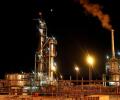
There is no payment problem for Russian crude, Petroleum and Natural Gas Minister Hardeep Singh Puri said on Wednesday. He said there is no proposal to cut retail fuel prices at the moment. Addressing a press conference, the minister said India enjoys a buyers' position and foreign suppliers are approaching Indian companies with offers to sell oil.

US President Donald Trump received a red carpet welcome in Beijing for talks with Chinese President Xi Jinping on trade, the Iran war, and other key issues. The visit underscores the importance both nations place on their relationship amid ongoing tensions.

Chief negotiators from India and the US are set to begin three-day talks in Washington to recalibrate the bilateral trade agreement (BTA) framework, following significant changes in the US tariff landscape, including a new 10 per cent tariff imposed on all countries.
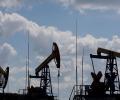
The government has no say in where the country's refiners source oil from because these are commercial transactions.

Modi also said that President Trump's leadership is vital for global peace, stability, and prosperity.

The Indian government has directed oil refineries to increase LPG production to ensure a stable supply of domestic cooking gas, amidst concerns over potential disruptions from the escalating Middle East conflict and its impact on imports.

India has stated it will wait for the outcome of the elections in Bangladesh and the resulting mandate before addressing any existing issues. The country also affirmed its support for free, fair, inclusive, and credible elections in Bangladesh.

Iran is fighting a different war: Older, slower, and in some ways more dangerous. Iran doesn't need to shoot down an F/A-18. It only needs to make the Strait of Hormuz feel dangerous long enough for insurance markets, shipping companies, and oil futures traders to do the rest. Prem Panicker continues his must-read daily blog on the war in the Middle East.

Prime Minister Narendra Modi stayed calm, avoided public confrontation, and focused on India's long-term interests to steady ties with the United States.
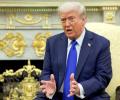
The US Representative criticised the administration's new USD 100,000 fee on H-1B visas, observing that Indians hold 70 per cent of these visas and saying the change directly harms workers who have long supported US innovation across technology, science and medicine.
Two days after Russian President Vladimir Putin concluded his visit to India, during which he assured that Moscow would remain a reliable energy supplier, the Kremlin on Monday said that India, as a sovereign nation, is free to buy oil from sources it deems beneficial. It expressed confidence that New Delhi will continue to prioritise its economic interests.

The turning point came with the appointment of Sergio Gor as the US ambassador to India.

Prime Minister Narendra Modi is deeply concerned by the war in Ukraine and his meeting with President Volodymyr Zelenskyy in New York demonstrates his commitment to finding a way forward and contributing in any way possible to a resolution of the conflict, Foreign Secretary Vikram Misri said.

AICC President Mallikarjun Kharge criticised Prime Minister Narendra Modi's relationship with US President Donald Trump, alleging that Modi is acting as Trump's 'slave' and jeopardising India's interests on trade, oil and foreign policy.
The US said India will lower tariffs on a "vast array" of American industrial and agricultural goods, such as "fruits, vegetables", to zero per cent under the trade deal announced by President Donald Trump.

US President Donald Trump asserted that the trade deal with India remains intact despite a Supreme Court ruling against his tariffs, while also claiming he used tariffs to stop a war between India and Pakistan.

A senior Russian diplomat has called the US pressure on India for its procurement of Russian crude oil "unjustified," expressing confidence in continued energy cooperation between India and Russia despite external pressures.

Foreign brokerages have started to cut their year-end targets for the Nifty 50 index amid the ongoing West Asia conflict.
India's import of discounted crude oil from the Russian Federation hit an all-time high in May, with state-run refiner IOC becoming the biggest importer of Russian oil, relegating Reliance Industries to the second place, trade and shipping data show. Indian imports of Russian oil, accounting for over 46 per cent of its total crude oil imports in May, have grown after strong backing by New Delhi, with state-run refiners powering imports of discounted crude. Discounts on Russian oil average around $10 a barrel, said an official from a state-run refiner. IOC's May purchases rose by 64 per cent on the month, and accounted for half of its total crude imports last month, ship tracking data show.

'There are times when India should stand up without hesitation and voice its indignation over the US' pressure tactic. This is one such moment,' asserts Ambassador M K Bhadrakumar.

India's exports to the US contracted 8.6 per cent to $6.3 billion in October, while imports rose 13.9 per cent to $4.5 billion leading to a trade surplus of $1.8 billion during the month.

It may now be time to question the price India is paying for Israel's disregard of the serious undermining of India's energy security, asserts former foreign secretary Shyam Saran.
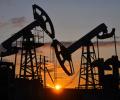
Reliance Industries' refining earnings will remain steady, supported by its position as India's largest importer of Russian crude and favourable global supplies, according to analysts at JM Financial and Goldman Sachs. Reliance imported more Russian barrels than any other Indian refiner in the past eight months, according to data from Bloomberg/Kpler.

He said that the US is financially and from a national security standpoint 'far stronger' and more respected than ever before because of tariffs.

India has rejected White House Trade advisor Peter Navarro's comments on New Delhi for its procurement of Russian crude oil, calling them 'inaccurate and misleading'. The relations between New Delhi and Washington are on a downturn after President Donald Trump doubled tariffs on Indian goods.

The enduring relationship between the two countries have survived the disintegration of the erstwhile USSR in 1991, the end of the Cold War and the regime change in both countries, points out Rup Narayan Das.

When missiles fly in this region, they are never just aimed at military targets.

India on Tuesday pitched for a stake in vast oil and gas fields as well as LNG terminals in the frozen Artic of Far East Russia as it looked to import more oil from the former Soviet republic as part of a strategy to diversify its energy basket.
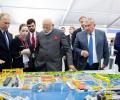
India is preoccupied with analysing the US sanctions, which may cut off India's access to discounted Russian crude and force it to buy at market prices.
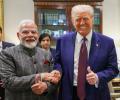
Trump announced that India and the US agreed to a trade deal under which Washington will charge a reduced reciprocal tariff on Delhi, lowering it from 25 per cent to 18 per cent.

'India is cosying up to Xi Jinping. They don't need the Russian oil. It's a refining profiteering scheme.'
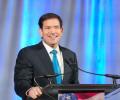
The US sees an opportunity to expand its strategic relationship with Pakistan but assures that it will not come at the expense of its ties with India, according to US Secretary of State Marco Rubio.
However, copious oil supplies amid growing global output and slowing Chinese oil consumption will put India in a better bargaining position with Gulf suppliers.

On the table are additional batches of S-400 surface-to-air missile systems from Russia, which India used with immense success during Operation Sindoor. India could buy at least two squadrons of Su-57 fighter jets plus joint production of S-500 air defence systems.

China has reacted positively to Russian President Vladimir Putin's visit to India, emphasizing the importance of trilateral ties between China, Russia, and India for regional and global peace and stability.

Egypt, Pakistan, Saudi Arabia and Turkey met in Islamabad in what analysts say is the formal opening of a new diplomatic formation that could reshape the post-war regional order. Their immediate goal is a ceasefire; their larger ambition is to ensure that neither Iran nor Israel emerges from this war in a dominant position. Pakistan's foreign minister then flew directly to Beijing and mooted a Chinese role as guarantor of any eventual agreement. Prem Panicker continues his must read daily blog on the Gulf War.
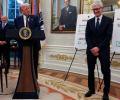
'India has intentionally taken advantage of the war in Ukraine to dramatically increase its purchases of Russian crude, when there are roughly 40 major crude providers that could satisfy Indian demand.'

This weekend, Donald Trump has begun to say the quiet part out loud -- that he wants to take control of Iran's oil, a formulation more in line with his robber-baron style of international relations.
 © 2026 Rediff.com - Advertise with us - Disclaimer - Privacy Policy - Sitemap - Feedback - About us - Terms of use - Grievances